.jpg)
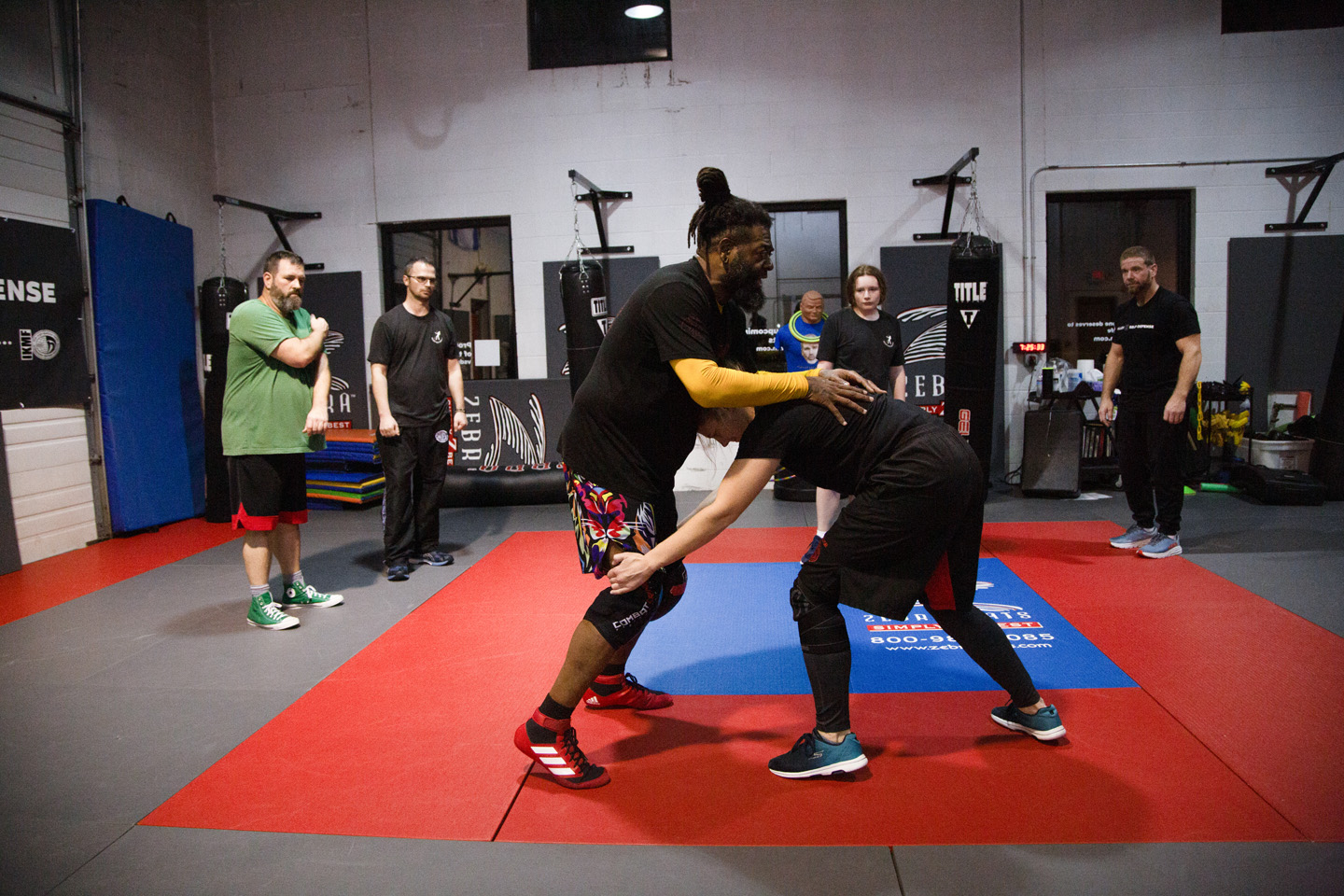
I’ve spent most of my professional life as a pastor, coach, and now a therapist. In all of these settings, I’ve listened to people talk about moments of stress, conflict, and transition. I’ve worked with leaders, law enforcement, families, organizations, and individuals who genuinely want to grow, heal, and lead well—yet still find themselves reacting in ways they don’t fully understand or can’t seem to control.
They know what they should do.
They just can’t always do it when pressure hits.
At the same time, I’ve spent years on the mat and in the ring—striking, grappling, teaching, and watching bodies tell the truth long before words ever do. I’ve trained and continue to instruct for over thirteen years in Krav Maga, spent 5 years deeply immersed in Brazilian Jiu-Jitsu, and another 5 year in and out of jits (Blue Belt, two stripes), and two years training in Muay Thai (green rank).
Across striking arts, grappling arts, and self-defense systems, I’ve seen the same patterns emerge how people respond to stress and pressure, how they negotiate boundaries, and how quickly the nervous system reveals what the mind tries to hide.
I’ve seen people learn how to breathe when pinned, soften instead of becoming rigid when defending punches, stay present instead of dissociating while searching for the nearest exit under attack, and find calm in the middle of intensity. I’ve watched confidence emerge—not from bravado, but from earned capability and nervous system stability.
A new question has been forming in me after years of training and coaching:
How can martial arts help with mental health—particularly grappling?
I know this isn’t a new question. You can find a hoodie anywhere that declares, “_____ is my therapy.” Boxing. Jiu-Jitsu. Muay Thai. Fill in the blank. And yes, I get it in a general way. But how does it really help? Is there a behavioral or nervous system science behind the punch, the kick, or even the takedown?
I’d say yes—and I want to know more.
So I’m beginning a new journey: one of Jit’s and mental health.
I sometimes wonder why we treat mental health as something that lives primarily in the mind, while ignoring the body—where stress often shows up first. Why do we expect people to regulate emotions they’ve never been taught to regulate physiologically? Why do we ask for resilience without training the systems that create it?
The more I’ve studied trauma, nervous system regulation, adult learning, healing, and embodied practice, the clearer it has become insight alone does not rewire survival patterns. Experience does.
The nervous system learns through repetition, safety, relationship, and graduated challenges. It learns by doing—not by being told.
Grappling, when taught well, quietly trains many of the exact capacities that mental health depends on:
- The ability to stay calm under pressure
- The ability to breathe and think at the same time
- The ability to set and respect boundaries
- The ability to recover quickly from stress
- The ability to trust and be trusted
- The ability to feel agency instead of helplessness
- The ability to belong without domination or submission as identity, outside of agreed-upon training roles
This series is not about turning martial arts into therapy or replacing clinical care. It is about recognizing that some of the most powerful mental health tools already exist—often unnoticed—inside disciplined physical practice.
I’m writing this series because I’m curious, and because I believe we need more integrated mental health strategies—ones that honor biology, relationship, culture, meaning, and mastery, not just cognition. Strategies that respect the intelligence of the body alongside the intelligence of the mind.
No, I’m not an expert in the field of mental health or even guru martial artists. I’m like most of you—a student of life; I’ve seen some things and have experienced some things, and I want to know more But I’ve seen what happens when training environments become trauma-informed, respectful, and developmentally intelligent. People don’t just get stronger—they become steadier. They communicate better. They recover faster. They lead with more humility and confidence. They experience less fear and more choice.
In a world increasingly marked by anxiety, polarization, disconnection, and reactivity, we need practices that teach people how to remain human under pressure.
The mat is one of those classrooms.
This 12-part series will explore how grappling trains the nervous system toward safety, regulation, agency, connection, and ultimately self-mastery—and how these lessons translate into leadership, healing, community, and everyday life.
My hope is that this work invites coaches, clinicians, leaders, parents, and practitioners to see training differently—not merely as physical conditioning or competition, but as a powerful laboratory for human development.
Because how we train our bodies shapes how we meet the world.

Just because you're small, doesn't mean you're out of the fight. Whether it's BJJ or Krav Maga, there are multiple ways you can win a fight, no matter your size.
People often tell us that they're too old to start a martial art. Our co-owner Peter started BJJ in his 50s and it changed his life.
Krav Maga near me? There is! If you're looking for a Krav Maga class near you, Valley Self-Defense is a proud member of the International Krav Maga Federation with schools located across the United States. To find a school near you, visit the IKMF USA website.


